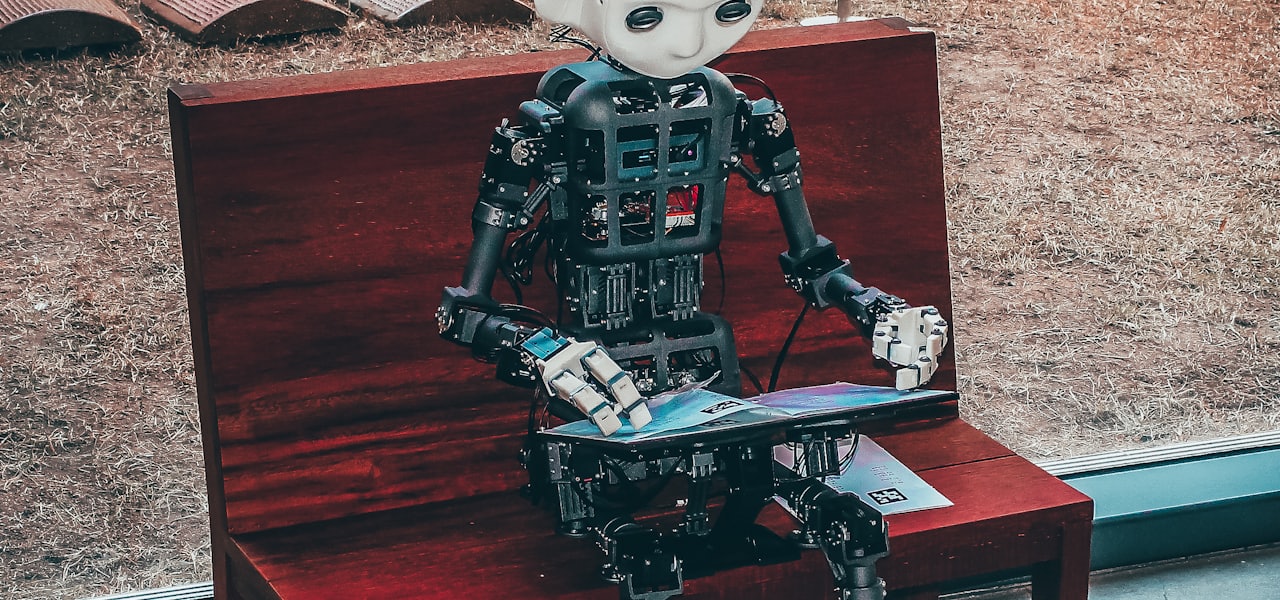
Ed was a chatbot co-developed by the Los Angeles Unified School District and AllHere Education. Described as a learning acceleration platform, it was the first personal assistant for students in the United States. Part of the district's Individual Acceleration Plan, it was able to interact with students both verbally and visually, offering support in 100 languages. The chatbot was launched on March 20, 2024, as part of the district's plan for academic recovery from the COVID-19 pandemic and to improve overall academic performance. Utilizing artificial intelligence, Ed organizes data and reports on grades, test scores, and attendance, creating individualized plans for each student. After the company behind it, AllHere, collapsed, the district shuttered operations of the chatbot on June 14, 2024. The firm is under investigation by the US Federal Bureau of Investigation. == History == On February 14, 2022, Alberto M. Carvalho became the Superintendent of the Los Angeles Unified School District, pledging to give the district a full academic recovery from the COVID-19 pandemic. In December 2022, he announced the Individual Acceleration Plan for the district, which aimed to provide each student with a unique progress report and help them determine if they were on track to graduate. The district faced criticism from disability advocates for its management of Individualized Education Programs, and in April 2022, the United States Department of Education announced that the district had failed to provide appropriate educational services to students with disabilities during the pandemic. The district had been grappling with significant absenteeism issues since the pandemic, which led to declining academic performance and disengagement among students. On February 17, 2023, the district issued a request for proposals to develop a fully integrated portal system. Later that year, they signed a $6 million, five-year contract with AllHere Education, a Boston-based company founded in 2016. The introduction of Ed follows the public launch of ChatGPT, which has been utilized by both teachers and students in educational settings. On August 4, 2023, during an annual address at the Walt Disney Concert Hall, Carvalho and the Los Angeles Unified School District announced the launch of Ed. The district invested $4 million into the chatbot, with Carvalho noting that this cost would be halved thanks to donor and grant funding. The chatbot was launched on March 20, 2024. Following its launch, a press conference was held to address security and technology concerns. Carvalho stated that the district had collaborated with security companies and incorporated filters to screen for threatening language. Months after its launch, AllHere Education furloughed most of its staff on June 14, citing their “current financial position” on its website as the reason. After learning about the furlough, the district terminated its dealings with AllHere Education. However, it stated its intention to bring the chatbot back in the future once officials determine the best course of action. Carvalho announced that he would appoint an independent task force to review what went wrong with AllHere Education and the chatbot. On February 25, 2026, the FBI served a search warrant on Carvalho’s home and office in connection with AllHere. The FBI also raided the LAUSD's headquarters. == Service == The chatbot was described as a personal assistant and a "one-stop shop for parents and students" who want to see information about a student's attendance and grades, as well as other resources from the district. Additionally, the application can function as an alarm clock, provide daily lunch menus from the school cafeteria, and offer updates on the location of school buses. The chatbot also helps students and parents who do not speak English as their first language by translating displayed information into approximately 100 different languages. The application can also help with submitting applications and give updates on progress and upcoming assignments. The district stated that the primary goal of Ed was to actively motivate students to complete homework and other tasks. == Reception == The chatbot received a mostly positive reception among parents and observers upon its launch. Some parents and teachers expressed caution about the technology, voicing concerns that the district's push for its implementation lacked public accountability. Rob Nelson from the University of Pennsylvania described the district's strategy as risky, saying that the release felt "like the beginning of a Clippy-level disaster". After the chatbot's shutdown, The 74 criticized it for misusing student data. Chris Whiteley, a former software engineer at AllHere Education, alleged that the data collected by the chatbot likely violated the district's data privacy rules.
Depop
Depop Limited is a social e-commerce company based in London, with additional offices in Milan and New York City. The company allows users to buy and sell items, which are mostly used and vintage pieces of clothing. == History == Depop was founded in 2011 by entrepreneur Simon Beckerman at an Italian technological incubator and business start-up centre, H-Farm. Beckerman came up with the original outline of the application during his time working on PIG, a fashion magazine based in Italy that he co-founded. The idea was to create a platform where products shown in the magazine could be purchased by users online. This idea turned into a concept similar to a flea market but on the internet, where people could sell their items while also being in control of advertising, public relations, and the creative process behind their accounts. While being financially supported by H-Farm, Beckerman worked within a team to create and lay out the Depop application while exposing it to numerous investors. In 2013, Beckerman became a member of the company's board to help improve the application and business while concurrently ceding his role of CEO. Maria Raga, Depop's co-founder and former CEO, took on the role of vice president of operations in 2014, and in 2016, she became chief executive. According to Raga, the main goal while developing Depop was to become the next Airbnb or Spotify, but to make an impact on fashion. Paolo Barberis and Nana Bianca were two of the first investors in the platform in 2012 with a seed investment. Its headquarters were moved to London in 2012. Depop expanded and opened additional offices in Milan and New York City. Beckerman raised €1 million in funding in October 2013 from Red Circle Investment and brought on Faroese Runar Reistrup as new CEO. In 2015, Depop secured another investment of $8 million from Balderton Capital and HV Capital. In March 2016, former CEO, Runar Reistrup, stated that Depop's growth was achieved through word of mouth. During his time as CEO, this growth involved taking Depop as a startup and working to raise funds to eventually amass a significant user base within the United States. In June 2019, Depop raised $62 million in Series C from General Atlantic to fund its expansion. Previous investors HV Capital, Balderton Capital, Creandum, Octopus Ventures, TempoCap and Sebastian Siemiatkowski also participated. During this time, Depop held workshops and conversations as part of their Depop Live NY events, and the company also opened a London store through their partnership with Selfridges. In 2020, Depop's gross merchandise sales and revenue both more than doubled to $650 million and $70 million respectively. This may be attributed to Depop's responsiveness to user trends, its lack of issues regarding inventory management, and the increase in users looking to resell. As of 2024, Depop has over 35 million users, according to their website. Depop is popular for Gen Z and young millennials, it is the 10th most-visited shopping platform for Gen Z consumers in the US, and, in a poll conducted by The Strategist in 2019, Depop was voted by teenagers as their favorite resale website. === Acquisition by Etsy === In June 2021, Depop was acquired by Etsy for $1.6 billion in cash, making it Etsy's most expensive acquisition; however, Depop continues to operate as a standalone brand independent from Etsy. This means that in addition to Depop keeping its existing team, the company retained its London location. At the time of acquisition, Etsy CEO Josh Silverman’s goal was to counteract the influx of buyers starting to go back to physical shops for their purchases. He saw Depop for its potential as a platform supporting a variety of products and creating a greater community of users. According to Silverman, Depop may expand and improve its services for its significant Gen Z user base. For Etsy, this acquisition maintains the company's foothold in the clothing industry and allows the company to expand its customer base to a younger demographic; at the same time, Depop is now able to make use of Etsy's company operations. When Maria Raga relinquished her position as Depop's CEO in 2022, Etsy assigned the role to Kruti Patel Goyal, who was Etsy's former chief product officer and a leader there for eleven years. When Goyal was appointed president and chief growth officer for Etsy in May, Peter Semple, former chief marketing officer, was assigned CEO of Depop officially on August 1st. === Acquisition by eBay === In February 2026, Etsy announced a proposed sale of Depop to eBay for $1.2 billion that was estimated to close within the year. == Business model == === Selling === Depop operates as a marketplace and social platform, where users can follow friends and other influencers to view their buying and selling activities. Through the platform, users are able to sell branded and designer items, as well as vintage pieces. Depop users are also encouraged by the platform to use other social networking services such as Instagram to promote their shop profiles. Celebrities have resold their own items on Depop, with some donating proceeds to charitable causes. Depop's user interface is modeled after that of Instagram. According to Depop, users who list and sell items provide their own photos with item descriptions. Users also note their designer items' authenticity and if they include any labels, tags, and receipts. These listings will appear in users' feeds. The platform's "Explore" page features items picked out by Depop staff. According to Depop, purchases are made via Apple Pay, Google Pay, credit and debit cards, and Klarna. Depop payments stay in-app, allowing for the company to mediate disputes and process refunds. Depop payments allow sellers to directly receive their payments in their bank account. To get paid by Depop, a seller has to add a bank account and verify their identification by uploading an ID. On July 18, 2024, Depop CEO Kruti Patel Goyal announced the removal of selling fees for US sellers, while maintaining a payment processing fee. This policy adjustment aimed to enhance seller revenue and support the growth of the second-hand market. === Buying === A Depop transaction includes the agreed sale price of the item, shipping fees, VAT or other applicable taxes and duties, and the marketplace fee for buyers in the U.S. or U.K. For international deliveries, packages may be subject to import taxes, customs duties, or fees, payable upon arrival or at checkout if Depop collects the tax on behalf of the buyer. For domestic purchases, relevant taxes may be collected by the seller or charged by the platform at checkout, ensuring no additional taxes are due upon delivery. For users in Australia, the United Kingdom, and the United States, Depop allows users to receive a full refund if their item does not arrive, arrives damaged, or is considerably different from the original when the issue is reported within 30 days. === Competitors === As of June 2021, Depop's competitors include Vinted, a platform founded by Milda Mitkute and Justas Janauskas in 2008 and valued at €3.5 billion, as well as the U.S. resale site Poshmark, valued at $3.5 billion. Additional competitors include Grailed, a peer-to-peer e-commerce site founded in 2014 that is recognized for its high-end second-hand menswear and streetwear, and Vestiaire Collection, a European resale app established in 2009 which specializes in authenticated pre-owned luxury items. The popularity of Depop has negatively impacted traditional second-hand stores, which can struggle to compete due to high labor costs and quality demands. There is an oversupply of clothes with the rise of fast fashion; this has taken a toll on the revenue aspect of the second-hand clothing industry. == Criticism == In November 2019, Business of Fashion reported that users within the Depop app were receiving sexually suggestive messages. In February 2020, Jessica Hamilton, a Depop buyer, reported that she found many scammers on the platform. She noticed this issue after she attempted to purchase a Nintendo Switch from a seller who would suspiciously only accept payment through a direct bank transfer without buyer protection. Hamilton blamed the company for its lack of action and relaxed security measures compared to other e-commerce sites, which made the platform especially susceptible to hackers. Without a clear strategy for managing scams, Depop lost some users' trust because of its negligence. In October 2020, some Depop buyers were tricked into paying sellers directly to bypass Depop's buyer protections, and the Depop sellers then sold those users' information on the dark web. In response, Depop claimed that it would improve security through mandatory password updates and multi-factor authentication. Users have criticized Depop for belatedly taking action against this issue.
Chaotic cryptology
Chaotic cryptology is the application of mathematical chaos theory to the practice of cryptography, the study or techniques used to privately and securely transmit information with the presence of a third-party or adversary. Since first being investigated by Robert Matthews in 1989, the use of chaos in cryptography has attracted much interest. However, long-standing concerns about its security and implementation speed continue to limit its implementation. Chaotic cryptology consists of two opposite processes: Chaotic cryptography and Chaotic cryptanalysis. Cryptography refers to encrypting information for secure transmission, whereas cryptanalysis refers to decrypting and deciphering encoded encrypted messages. In order to use chaos theory efficiently in cryptography, the chaotic maps are implemented such that the entropy generated by the map can produce required Confusion and diffusion. Properties in chaotic systems and cryptographic primitives share unique characteristics that allow for the chaotic systems to be applied to cryptography. If chaotic parameters, as well as cryptographic keys, can be mapped symmetrically or mapped to produce acceptable and functional outputs, it will make it next to impossible for an adversary to find the outputs without any knowledge of the initial values. Since chaotic maps in a real life scenario require a set of numbers that are limited, they may, in fact, have no real purpose in a cryptosystem if the chaotic behavior can be predicted. One of the most important issues for any cryptographic primitive is the security of the system. However, in numerous cases, chaos-based cryptography algorithms are proved insecure. The main issue in many of the cryptanalyzed algorithms is the inadequacy of the chaotic maps implemented in the system. == Types == Chaos-based cryptography has been divided into two major groups: Symmetric chaos cryptography, where the same secret key is used by sender and receiver. Asymmetric chaos cryptography, where one key of the cryptosystem is public. Some of the few proposed systems have been broken. The majority of chaos-based cryptographic algorithms are symmetric. Many use discrete chaotic maps in their process. == Applications == === Image encryption === Bourbakis and Alexopoulos in 1991 proposed supposedly the earliest fully intended digital image encryption scheme which was based on SCAN language. Later on, with the emergence of chaos-based cryptography hundreds of new image encryption algorithms, all with the aim of improving the security of digital images were proposed. However, there were three main aspects of the design of an image encryption that was usually modified in different algorithms (chaotic map, application of the map and structure of algorithm). The initial and perhaps most crucial point was the chaotic map applied in the design of the algorithms. The speed of the cryptosystem is always an important parameter in the evaluation of the efficiency of a cryptography algorithm, therefore, the designers were initially interested in using simple chaotic maps such as tent map, and the logistic map. However, in 2006 and 2007, the new image encryption algorithms based on more sophisticated chaotic maps proved that application of chaotic map with higher dimension could improve the quality and security of the cryptosystems. === Hash function === Chaotic behavior can generate hash functions, such as applying the Chirikov/Julia 3D trajectory translation into a SHA-512 hash. === Random number generation === The unpredictable behavior of the chaotic maps can be used in the generation of random numbers. Some of the earliest chaos-based random number generators tried to directly generate random numbers from the logistic map. Many more recent works did so using the numerical solutions of hyperchaotic systems of differential equations, either at the integer-order, or the fractional-order.
Web presence
A web presence is a location on the World Wide Web where a person, business, or some other entity is represented (see also web property and point of presence). Examples of a web presence for a person could be a personal website, a blog, a profile page, a wiki page, or a social media point of presence (e.g. a LinkedIn profile, a Facebook account, or a Twitter account). Examples of a web presence for a business or some other entity could be a corporate website, a microsite, a page on a review site, a wiki page, or a social media point of presence (e.g., a LinkedIn company page and/or group, a Facebook business/brand/product page, or a Twitter account). Every web presence is associated with a unique web address to distinguish one point of presence from another. == Owned vs. unowned == Web presence can either be owned or unowned. Owned media exists when a single person or group can control the content that is published on its web presence (e.g. a corporate website or a personal Twitter account). However, when a single person or group cannot solely control the content, the creator is different from the owner. This is considered unowned media (see earned media). A Wikipedia page or a Yelp page about a person, company, or product would be an example of a known (or "earned") web presence. Occasionally, a first form of media known as "paid media" is often included in the discussion of media types: "earned vs. owned vs. paid". Paid media is commonly found in the form of advertisements, but it is not considered a form of web presence. == Management == Web presence management is the process of establishing and maintaining a digital footprint on the web. The three factors that are considered include the following: where a person or business has web presence; how each web presence represents its enterprise; and what is published at a point of presence. Web presence management is the discipline of determining and governing: the distribution of policy documents which platforms are most appropriate (e.g. internal vs. external blog, YouTube vs. Vimeo) the single inventory of personal or corporate web presence (e.g. partners or advocates) where on the web a business and any relatable assets are represented where on the web a business and any relatable assets are impersonated or pirated web properties with the particular entities they represent who has control over which web properties new web properties which are not in the personal or corporate inventory (e.g. someone creates a new presence) authorized and unauthorized changes to the creation (e.g. branding) of a web presence a workflow for creating a web property that follows its corporate standards === Management system === The purpose of a web presence management system is to manage the web presence of a person or business. This includes the collection of domain names, websites, social media, and other web pages where he, she, or it is being represented. The tool generally offers the following key functions: new presence discovery, inventory management, change detection, access control, stakeholder coordination, and compliance workflow. A web presence management system is meant to have a broader reach so that it emphasizes where a presence has been established, will be established, must be maintained, or must be remediated. An example of a web presence management system is the Brandle Presence Manager. In order to publish content to the various points of web presence, multiple content management systems and sometimes even social media management systems are often used. The primary focus of most content and social media management systems is limited to their specific web platforms. === Domain names === Another aspect of web presence management is managing the collection of domain names registered to the person or business. Any entity may register multiple domain names for the same property. As a result, they can link alternative spellings, different top-level domains, aliases, brands, or products to the same website. Similarly, negative or derogatory domain names may also be registered. This is done to prevent certain domain names from being used against the person or business. It is common for a larger business to have domain names registered by multiple employees at multiple domain name registrars, possibly a result of organizational or geographical requirements. Consequently, a web presence management system can be used to monitor all domain names registered by the business, regardless of the registrars used. == Discovery == Web presence discovery is the process of monitoring the web for a new point of presence about a person or business. Web presence discovery is often included in a web presence management system. Whether a new domain is registered, a new website is published, or a new social media account is established, it occurs outside of the person's or business’ control. As a result, its purpose is to assess a new point of presence and appropriately handle any violations. Web presence discovery differs from content listening. The former involves looking for new properties on the web, whereas the latter refers to analyzing content that already exists to hear how a person or business is seen often in near real time. Examples of content listening systems include Sysomos and Radian6, which is now a subsidiary of Salesforce.com. === Brand protection === A person or business may choose to watch for a new web presence that might appear to misrepresent or mislead an audience, such as counterfeiters, spoofers, or malicious hackers. One of the early software in the online brand protection marketplace was MarkMonitor, now part of Thomson Reuters. This software helped detect rogue domain names and websites. However, the modern day growth of social media has seen a rise in the number of fraudulent brand impersonations. It has become much easier for a new web presence to be created on those platforms, which results in a greater frequency of them today. As a preventive measure, online brand protection providers are now adding social media to their domain and website discovery options. === Security === The widespread growth of social media has also made it easier for unauthorized individuals to impersonate an employee. Consequently, social media has now become a recognized threat vector in that it can be used to socially engineer an attack on a business. To counter this, companies are able to use web presence monitoring tools to detect new points of presence on the web and thereby defend against socially engineered attacks. === Distributed inventory management === A web presence monitoring system can be used by a business to associate a new web property with its corporate inventory. It is designed to address autonomous, distributed behaviors. This usually applies to larger businesses whose geographically diverse employees are more prone to creating new points of presence on the web. For example, a retail chain may allow each local store to create and manage their web presence to market to and communicate with their local customer base. Similarly, a global business may have teams in each country or region who create and manage a web presence to adapt to local languages or cultures. == Monitoring == Web presence monitoring is the process of monitoring a known inventory of web presence to detect any changes that are made. Web presence monitoring is often included in a web presence management system and can serve multiple purposes for both larger corporations and certain individuals, such as celebrities. It is important to note that presence monitoring differs from content listening. The former involves monitoring the properties (e.g. branding) of a web property in an established inventory, whereas the latter refers to analyzing content that already exists to hear how a person or business is seen often in near real time. Additionally, presence monitoring focuses on owned media and content listening on earned media. === Corporate, brand, and regulatory compliance === Many companies ensure that certain standards are met for a property on the web that represents their business. For companies in regulated industries, such as finance and healthcare, the company may be required by law to ensure that all publicized content, regardless of platform or technology, follow specific requirements. The widespread growth of social media has seen a rise in the number of fraudulent corporate impersonations. It has become much easier for a new web presence to be created on these platforms, and so these are much more prevalent than they used to be. As a preventive measure, a web presence monitoring system alerts the company when a known property is changed, allowing for the property to be reviewed and amended so that it follows the proper standards. . A web presence monitoring system helps alert the company when a known property is changed, so it can be reviewed and brought back, if necessary, into compliance with the appro
CANaerospace
CANaerospace is a higher layer protocol based on Controller Area Network (CAN) which has been developed by Stock Flight Systems in 1998 for aeronautical applications. == Background == CANaerospace supports airborne systems employing the Line-replaceable unit (LRU) concept to share data across CAN and ensures interoperability between CAN LRUs by defining CAN physical layer characteristics, network layers, communication mechanisms, data types and aeronautical axis systems. CANaerospace is an open source project, was initiated to standardize the interface between CAN LRUs on the system level. CANaerospace is continuously being developed further and has also been published by NASA as the Advanced General Aviation Transport Experiments Databus Standard in 2001. It found widespread use in aeronautical research worldwide. A major research aircraft that employs several CANaerospace networks for real-time computer interconnection is the Stratospheric Observatory for Infrared Astronomy (SOFIA), a Boeing 747SP with a 2.5m astronomic telescope. CANaerospace is also frequently used in flight simulation and connects entire aircraft cockpits (i.e. in Eurofighter Typhoon simulators) to the simulation host computers. In Italy CANaerospace is used as UAV data bus technology. Furthermore, CANaerospace serves as communication network in several general aviation avionics systems. The CANaerospace interface definition closes the gap between the ISO/OSI layer 1 and 2 CAN protocol (which is implemented in the CAN controller itself) and the specific requirements of distributed systems in aircraft. It may be used as a primary or ancillary avionics network and was designed to meet the following requirements: Democratic network: CANaerospace does not require any master/slave relationships between LRUs or a "bus controller", thereby avoiding a potential single source of failure. Every node in the network has the same rights for participation in the bus traffic. Self-identifying message format: Each CANaerospace message contains information about the type of the data and the transmitting node. This allows the data to be unambiguously recognized at each receiving node. Continuous Message Numbering: Each CANaerospace message contains a continuously incremented number which allows coherent processing of messages in the receiving stations. Message Status Code: Each CANaerospace message contains information about the integrity of the data is conveying. This allows receiving stations to evaluate the quality of the received data and to react accordingly. Emergency Event Signaling: CANaerospace defines a mechanism that allows each node to transmit information about exception or error situations. This information can be used by other stations to determine the network health. Node Service Interface: As an enhancement to CAN, CANaerospace provides a means for individual stations on the network to communicate with each other using connection-oriented and connectionless services. Predefined CAN Identifier Assignment: CANaerospace offers a predefined identifier assignment list for normal operation data. In addition to the predefined list, user-defined identifier assignment lists may be used. Ease of Implementation: The amount of code to implement CANaerospace is very little by design in order to minimize the effort for testing and certification of flight safety critical systems. Openness to Extensions: All CANaerospace definitions are extendable to provide flexibility for future enhancements and to allow adaptions to the requirements of specific applications. Free Availability: No cost whatsoever apply for the use of CANaerospace. The specification can be downloaded from the Internet == Physical interface == To ensure interoperability and reliable communication, CANaerospace specifies the electrical characteristics, bus transceiver requirements and data rates with the corresponding tolerances based on ISO 11898. The bit timing calculation (baud rate accuracy, sample point definition) and robustness to electromagnetic interference are given special emphasis. Also addressed are CAN connector, wiring considerations and design guidelines to maximize electromagnetic compatibility. == Communication layers == The Bosch CAN specification itself allows messages being transmitted both periodically and aperiodically but does not cover issues like data representation, node addressing or connection-oriented protocols. CAN is entirely based on Anyone-to-Many (ATM) communication which means that CAN messages are always received by all stations in the network. The advantage of the CAN concept is inherent data consistency between all stations, the drawback is that it does not allow node addressing which is the basis for Peer-to-Peer (PTP) communication. Using CAN networks in aeronautical applications, however, demands a standard targeted to the specific requirements of airborne systems which implies that communication between individual stations in the network must be possible to enable the required degree of system monitoring. Consequently, CANaerospace defines additional ISO/OSI layer 3, 4 and 6 functions to support node addressing and unified ATM/PTP communication mechanisms. PTP communication allows to set up client/server interactions between individual stations in the network either temporarily or permanently. More than one of these interactions may be in effect at any given time and each node may be client for one operation and server for another at the same time. This CANaerospace mechanism is called "Node Service Concept" and allows i.e. to distribute system functions over several stations in the network or to control dynamic system reconfiguration in case of failure. The Node Service concept supports both connection-oriented and connectionless interactions like with TCP/IP and UDP/IP for Ethernet. Enabling both ATM and PTP communication for CAN requires the introduction of independent network layers to isolate the different types of communication. This is realized for CANaerospace by forming CAN identifier groups as shown in Figure 1. The resulting structure creates Logical Communication Channels (LCCs) and assigns a specific communication type (ATM, PTP) to each of the LCCs. User-defined LCCs provide the necessary freedom for designers and allow the implementation of CANaerospace according to the needs of specific applications. Figure 1: Logical Communication Channels for CANaerospace As a side effect, the CAN identifier groups in Figure 1 affect the priority of the message transmission in case of bus arbitration. The communication channels are therefore arranged according to their relative importance: Emergency Event Data Channel (EED): This communication channel is used for messages which require immediate action (i.e. system degradation or reconfiguration) and have to be transmitted with very high priority. Emergency Event Data uses ATM communication exclusively. High/Low Priority Node Service Data Channel (NSH/NSL): These communication channels are used for client/server interactions using PTP communication. The corresponding services may be of the connection-oriented as well as the connectionless type. NSH/NSL may also be used to support test and maintenance functions. Normal Operation Data Channel (NOD): This communication channel is used for the transmission of the data which is generated during normal system operation and described in the CANaerospace identifier assignment list. These messages may be transmitted periodically or aperiodically as well as synchronously or asynchronously. All messages which cannot be assigned to other communication channels shall use this channel. High/Low Priority User-Defined Data Channel (UDH/UDL): This channel is dedicated to communication which cannot, due to their specific characteristics, be assigned other channels without violating the CANaerospace specification. As long as the defined identifier range is used, the message content and the communication type (ATM, PTP) for these channels may be specified by the system designer. To ensure interoperability it is highly recommended that the use of these channels is minimized. Debug Service Data Channel (DSD): This channel is dedicated to messages which are used temporarily for development and test purposes only and are not transmitted during normal operation. As long as the defined identifier range is used, the message content and the communication type (ATM, PTP) for these channels may be specified by the system designer. == Data representation == The majority of the real-time control systems used in aeronautics employ "big endian" processor architectures. This data representation was therefore specified for CANaerospace as well. With big endian data representation, the most significant bit of any datum is arranged leftmost and transmitted first on CANaerospace as shown in Figure 2. Figure 2: "Big Endian" Data Representation for CANaerospace CANaerospace uses a self-identifying message
Sketch Engine
Sketch Engine is a corpus manager and text analysis software developed by Lexical Computing since 2003. Its purpose is to enable people studying language behaviour (lexicographers, researchers in corpus linguistics, translators or language learners) to search large text collections according to complex and linguistically motivated queries. Sketch Engine gained its name after one of the key features, word sketches: one-page, automatic, corpus-derived summaries of a word's grammatical and collocational behaviour. Currently, it supports and provides corpora in over 100 languages. == History of development == Sketch Engine is a product of Lexical Computing, a company founded in 2003 by the lexicographer and research scientist Adam Kilgarriff. He started a collaboration with Pavel Rychlý, a computer scientist working at the Natural Language Processing Centre, Masaryk University, and the developer of Manatee and Bonito (two major parts of the software suite). Kilgarriff also introduced the concept of word sketches. Since then, Sketch Engine has been commercial software, however, all the core features of Manatee and Bonito that were developed by 2003 (and extended since then) are freely available under the GPL license within the NoSketch Engine suite. == Features == A list of tools available in Sketch Engine: Word sketches – a one-page automatic derived summary of a word's grammatical and collocational behaviour Word sketch difference – compares and contrasts two words by analysing their collocations Distributional thesaurus – automated thesaurus for finding words with similar meaning or appearing in the same/similar context Concordance search – finds occurrences of a word form, lemma, phrase, tag or complex structure Collocation search – word co-occurrence analysis displaying the most frequent words (for a search word) which can be regarded as collocation candidates Word lists – generates frequency lists which can be filtered with complex criteria n-grams – generates frequency lists of multi-word expressions Terminology / Keyword extraction (both monolingual and bilingual) – automatic extraction of key words and multi-word terms from texts (based on frequency count and linguistic criteria) Diachronic analysis (Trends) – detecting words which undergo changes in the frequency of use in time (show trending words) Corpus building and management – create corpora from the Web or uploaded texts including part-of-speech tagging and lemmatization which can be used as data mining software Parallel corpus (bilingual) facilities – looking up translation examples (EUR-Lex corpus, Europarl corpus, OPUS corpus, etc.) or building a parallel corpus from own aligned texts Text type analysis – statistics of metadata in the corpus === Keywords and terminology extraction === Sketch Engine can perform automatic term extraction by identifying words typical of a particular corpus, document, or text. Single words and multi-word units can be extracted from monolingual or bilingual texts. The terminology extraction feature provides a list of relevant terms based on comparison with a large corpus of general language. This functionality is also available as a separate service called OneClick Terms with a dedicated interface. === SKELL === A free web service based on Sketch Engine and aimed at language learners and teachers is SKELL (formerly SkELL). It exploits Sketch Engine's proprietary GDEX (Good Dictionary Examples) scoring function to provide authentic example sentences for specific target words. Results are drawn from a special corpus of high-quality texts covering everyday, standard, formal, and professional language and displayed as a concordance. SKELL also includes simplified versions of Sketch Engine's word sketch and thesaurus functions. It has been suggested that SKELL can be used, for instance, to help students understand the meaning and/or usage of a word or phrase; to help teachers wanting to use example sentences in a class; to discover and explore collocates; to create gap-fill exercises; to teach various kinds of homonyms and polysemous words. SKELL was first presented in 2014, when only English was supported. Later, support was added for Russian, Czech, German, Italian and Estonian. == List of text corpora == Sketch Engine provides access to more than 800 text corpora. There are monolingual as well as multilingual corpora of different sizes (from one thousand words up to 85 billion words) and various sources (e.g. web, books, subtitles, legal documents). The list of corpora includes British National Corpus, Brown Corpus, Cambridge Academic English Corpus and Cambridge Learner Corpus, CHILDES corpora of child language, OpenSubtitles (a set of 60 parallel corpora), 24 multilingual corpora of EUR-Lex documents, the TenTen Corpus Family (multi-billion web corpora), and Trends corpora (monitor corpora with daily updates). == Architecture == Sketch Engine consists of three main components: an underlying database management system called Manatee, a web interface search front-end called Bonito, and a web interface for corpus building and management called Corpus Architect. === Manatee === Manatee is a database management system specifically devised for effective indexing of large text corpora. It is based on the idea of inverted indexing (keeping an index of all positions of a given word in the text). It has been used to index text corpora comprising tens of billions of words. Searching corpora indexed by Manatee is performed by formulating queries in the Corpus Query Language (CQL). Manatee is written in C++ and offers an API for a number of other programming languages including Python, Java, Perl and Ruby. Recently, it was rewritten into Go for faster processing of corpus queries. === Bonito === Bonito is a web interface for Manatee providing access to corpus search. In the client–server model, Manatee is the server and Bonito plays the client part. It is written in Python. === Corpus Architect === Corpus Architect is a web interface providing corpus building and management features. It is also written in Python. == Applications == Sketch Engine has been used by major British and other publishing houses for producing dictionaries such as Macmillan English Dictionary, Dictionnaires Le Robert, Oxford University Press or Shogakukan. Four of United Kingdom's five biggest dictionary publishers use Sketch Engine.
Backdoor (computing)
A backdoor is a typically covert method of bypassing normal authentication or encryption in a computer, product, embedded device (e.g. a home router), or its embodiment (e.g. part of a cryptosystem, algorithm, chipset, or even a "homunculus computer"—a tiny computer-within-a-computer such as that found in Intel's AMT technology). Backdoors are most often used for securing remote access to a computer, or obtaining access to plaintext in cryptosystems. From there it may be used to gain access to privileged information like passwords, corrupt or delete data on hard drives, or transfer information within compromised networks. In the United States, the 1994 Communications Assistance for Law Enforcement Act forces internet providers to provide backdoors for government authorities. In 2024, the U.S. government realized that China had been tapping communications in the U.S. using that infrastructure for months, or perhaps longer; China recorded presidential candidate campaign office phone calls—including employees of the then-vice president of the nation, and of the candidates themselves. A backdoor may take the form of a hidden part of a program, a separate program (e.g. Back Orifice may subvert the system through a rootkit), code in the firmware of the hardware, or parts of an operating system such as Windows, for example, device drivers. Trojan horses can be used to create vulnerabilities in a device. A Trojan horse may appear to be an entirely legitimate program, but when executed, it triggers an activity that may install a backdoor. Although some are secretly installed, other backdoors are deliberate and widely known. These kinds of backdoors have "legitimate" uses such as providing the manufacturer with a way to restore user passwords. Many systems that store information within the cloud fail to create accurate security measures. If many systems are connected within the cloud, hackers can gain access to all other platforms through the most vulnerable system. Default passwords (or other default credentials) can function as backdoors if they are not changed by the user. Some debugging features can also act as backdoors if they are not removed in the release version. In 1993, the United States government attempted to deploy an encryption system, the Clipper chip, with an explicit backdoor for law enforcement and national security access. The chip was unsuccessful. Recent proposals to counter backdoors include creating a database of backdoors' triggers and then using neural networks to detect them. == Overview == The threat of backdoors surfaced when multiuser and networked operating systems became widely adopted. Petersen and Turn discussed computer subversion in a paper published in the proceedings of the 1967 AFIPS Conference. They noted a class of active infiltration attacks that use "trapdoor" entry points into the system to bypass security facilities and permit direct access to data. The use of the word trapdoor here clearly coincides with more recent definitions of a backdoor. However, since the advent of public key cryptography the term trapdoor has acquired a different meaning (see: Trapdoor function), and thus the term "backdoor" is now preferred, only after the term trapdoor went out of use. More generally, such security breaches were discussed at length in a RAND Corporation task force report published under DARPA sponsorship by J.P. Anderson and D.J. Edwards in 1970. While initially targeting the computer vision domain, backdoor attacks have expanded to encompass various other domains, including text, audio, ML-based computer-aided design, and ML-based wireless signal classification. Additionally, vulnerabilities in backdoors have been demonstrated in deep generative models, reinforcement learning (e.g., AI GO), and deep graph models. These broad-ranging potential risks have prompted concerns from national security agencies regarding their potentially disastrous consequences. A backdoor in a login system might take the form of a hard coded user and password combination which gives access to the system. An example of this sort of backdoor was used as a plot device in the 1983 film WarGames, in which the architect of the "WOPR" computer system had inserted a hardcoded password-less account which gave the user access to the system, and to undocumented parts of the system (in particular, a video game-like simulation mode and direct interaction with the artificial intelligence). Although the number of backdoors in systems using proprietary software (software whose source code is not publicly available) is not widely credited, they are nevertheless frequently exposed. Programmers have even succeeded in secretly installing large amounts of benign code as Easter eggs in programs, although such cases may involve official forbearance, if not actual permission. == Examples == === Worms === Many computer worms, such as Sobig and Mydoom, install a backdoor on the affected computer (generally a PC on broadband running Microsoft Windows and Microsoft Outlook). Such backdoors appear to be installed so that spammers can send junk e-mail from the infected machines. Others, such as the Sony/BMG rootkit, placed secretly on millions of music CDs through late 2005, are intended as DRM measures—and, in that case, as data-gathering agents, since both surreptitious programs they installed routinely contacted central servers. A sophisticated attempt to plant a backdoor in the Linux kernel, exposed in November 2003, added a small and subtle code change by subverting the revision control system. In this case, a two-line change appeared to check root access permissions of a caller to the sys_wait4 function, but because it used assignment = instead of equality checking ==, it actually granted permissions to the system. This difference is easily overlooked, and could even be interpreted as an accidental typographical error, rather than an intentional attack. In January 2014, a backdoor was discovered in certain Samsung Android products, like the Galaxy devices. The Samsung proprietary Android versions are fitted with a backdoor that provides remote access to the data stored on the device. In particular, the Samsung Android software that is in charge of handling the communications with the modem, using the Samsung IPC protocol, implements a class of requests known as remote file server (RFS) commands, that allows the backdoor operator to perform via modem remote I/O operations on the device hard disk or other storage. As the modem is running Samsung proprietary Android software, it is likely that it offers over-the-air remote control that could then be used to issue the RFS commands and thus to access the file system on the device. === Object code backdoors === Harder to detect backdoors involve modifying object code, rather than source code—object code is much harder to inspect, as it is designed to be machine-readable, not human-readable. These backdoors can be inserted either directly in the on-disk object code, or inserted at some point during compilation, assembly linking, or loading—in the latter case the backdoor never appears on disk, only in memory. Object code backdoors are difficult to detect by inspection of the object code, but are easily detected by simply checking for changes (differences), notably in length or in checksum, and in some cases can be detected or analyzed by disassembling the object code. Further, object code backdoors can be removed (assuming source code is available) by simply recompiling from source on a trusted system. Thus for such backdoors to avoid detection, all extant copies of a binary must be subverted, and any validation checksums must also be compromised, and source must be unavailable, to prevent recompilation. Alternatively, these other tools (length checks, diff, checksumming, disassemblers) can themselves be compromised to conceal the backdoor, for example detecting that the subverted binary is being checksummed and returning the expected value, not the actual value. To conceal these further subversions, the tools must also conceal the changes in themselves—for example, a subverted checksummer must also detect if it is checksumming itself (or other subverted tools) and return false values. This leads to extensive changes in the system and tools being needed to conceal a single change. As object code can be regenerated by recompiling (reassembling, relinking) the original source code, making a persistent object code backdoor (without modifying source code) requires subverting the compiler itself—so that when it detects that it is compiling the program under attack it inserts the backdoor—or alternatively the assembler, linker, or loader. As this requires subverting the compiler, this in turn can be fixed by recompiling the compiler, removing the backdoor insertion code. This defense can in turn be subverted by putting a source meta-backdoor in the compiler, so that when it detects that it is compiling itself